.png)


WHAT IS CYSTOSCOPY?
Diagnosis and Treatment with Bladder Camera
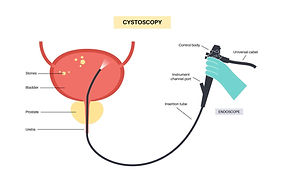
Cystoscopy is a modern urological diagnostic procedure that allows the inside of the bladder and urethra to be examined using a thin camera. It is also commonly known as bladder examination with a camera.
Cystoscopy allows doctors to diagnose problems in the urinary tract by directly visualizing them.
Why is a cystoscopy performed?
Cystoscopy is frequently used to investigate the following conditions:
Blood in the urine
Frequent urination
Burning or pain while urinating
Recurrent urinary tract infection
Suspected bladder stone
Suspected bladder tumor
Difficulty urinating
It is one of the most valuable diagnostic methods, especially in cases of unexplained urinary complaints.
How is a cystoscopy performed?
Cystoscopy procedure:
It is usually performed under local anesthesia.
A thin camera system is inserted through the urethra.
The inner surface of the bladder is examined in detail.
Biopsies or minor procedures may be performed if necessary.
The process takes approximately 5-10 minutes.
The patient can often return to normal life the same day.
What is the purpose of cystoscopy?
The main purpose of cystoscopy is:
Early diagnosis of bladder diseases
Determining the cause of urinary tract problems
To perform minor treatments simultaneously, if necessary.
WHAT IS URETERORENOSCOPY (URS)?
Closed Treatment for Kidney and Ureter Stones
Ureterorenoscopy (URS) is a minimally invasive surgical procedure that allows for the examination and treatment of the kidney and the ureter (the urinary tract extending from the kidney to the bladder) using a camera.
This procedure is used particularly in the treatment of kidney stones and ureteral stones .
Why is ureterorenoscopy performed?
URS procedure is applied in the following situations:
Kidney stone
Ureter stone
Urinary tract obstruction
narrowing of the urethra
Investigation of the cause of the suspected mass or bleeding.
How is ureterorenoscopy performed?
The procedure is usually performed under anesthesia.
The ureter is reached by entering through the urethra.
A thin camera system is used to visualize the stone or problematic area.
If there are stones, they are broken up and removed with a laser.
No open surgery is required.
No incisions are made on the body.
The process usually takes 30-60 minutes.
What is the purpose of ureterorenoscopy?
To remove kidney and ureter stones.
To relieve urinary tract obstruction.
Protecting kidney function
To eliminate pain