.png)


What Is Male Infertility?
Male infertility is a condition in which the male factor contributes to the inability to achieve pregnancy despite regular, unprotected intercourse.
In simple terms, the problem may be related to:
-
Sperm production
-
Sperm quality
-
Sperm transport
Infertility is not solely a female issue. Therefore, it is important that both partners are evaluated together during the assessment process.
How Does the Male Reproductive System Work?
The male reproductive system consists of organs responsible for sperm production, maturation, and transport.
Main Structures:
-
Testis: Produces sperm and secretes the male hormone testosterone
-
Epididymis: Where sperm mature
-
Vas deferens (sperm duct): Transports sperm
-
Seminal vesicles: Produce most of the fluid that makes up semen
-
Prostate: Provides protective fluid for sperm
-
Urethra: The channel through which sperm are ejaculated
A problem in any part of this system can make pregnancy more difficult.
How Are Sperm Produced?
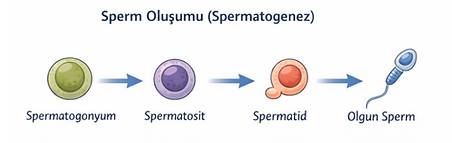
Sperm production takes place in the testicles and goes through several stages:
→ Spermatogonium → Spermatocyte → Spermatid → Mature sperm
Once this process is completed, sperm capable of fertilization are formed.
Causes of Male Infertility
Male infertility is generally evaluated in three main categories:
1. Hormonal Causes
Insufficient signals from the brain to the testicles may impair sperm production.
2. Testicular Causes
-
Varicocele
-
Genetic factors
-
History of undescended testis
-
Infections
-
Chemotherapy / radiotherapy
-
Environmental factors
3. Obstructive Causes
-
Blockage in the sperm ducts
-
Absence of the vas deferens
-
Post-infectious damage
How Is Male Infertility Evaluated?
Evaluation includes the following steps:
-
Medical history
-
Physical examination
-
Laboratory tests
Testicular structure and the presence of varicocele provide important clues during this process.
What Tests Are Performed for Diagnosis?
Semen Analysis (Spermiogram)
This is the most fundamental test in male infertility. It evaluates:
-
Sperm count
-
Motility (movement)
-
Morphology (shape)
Hormone Tests
-
Testosterone
-
FSH
-
LH
Genetic Tests
-
Karyotype analysis
-
Y chromosome evaluation
Ultrasound
Used to assess testicular structure and detect varicocele.
Treatment of Male Infertility
Treatment is determined based on the underlying cause.
Medical Treatment
May be used in hormonal or infection-related conditions.
Varicocele Surgery
Varicocele is the enlargement of veins around the testicle and may affect sperm production.
With microscopic varicocelectomy:
-
Harmful veins are ligated
-
Vessels supplying the testicle are preserved
-
Sperm quality may improve
Micro-TESE
In some men, no sperm are found in the semen (azoospermia).
In such cases:
Using the Micro-TESE method, testicular tissue is examined under a microscope to search for sperm. Retrieved sperm can then be used in IVF (in vitro fertilization) treatment.
Frequently Asked Questions
What is the first step in evaluating male infertility?
Medical history, physical examination, and semen analysis.
Does varicocele always cause infertility?
No. Not every varicocele requires treatment.
Who is Micro-TESE performed for?
It may be performed in patients with no sperm detected in the semen.
Conclusion
Male infertility is often a treatable condition. With proper evaluation and appropriate treatment, achieving parenthood is possible for many couples.