.png)
What is Urethral Stricture? Symptoms, Causes, and Early Signs
- Zafer Aybek
- Apr 8
- 3 min read

What is urethral stricture?
Urethral stricture is the narrowing of the urethra, which is normally flexible and expandable, due to scar tissue formation caused by various reasons. This narrowing makes it difficult for urine to flow out of the bladder and can eventually lead to partial or complete obstruction of the urethra.
A healthy urethra can expand to accommodate urine flow, but this flexibility is lost when a narrowing develops. Hard, fibrotic tissue within the canal obstructs the smooth passage of urine. While this condition may initially present with mild symptoms, it can progress over time and lead to more serious problems.
How and why does urethral stricture occur?
After addressing the question of what urethral stricture is, let's focus on how and why it occurs. Urethral stricture usually develops when the healing process following an injury becomes uncontrolled. Normally, tissue healing should be limited; however, in some cases, excessive scar tissue forms, causing the canal to narrow.
The most common causes are:
After medical procedures (most common cause)
Today, the most common cause of urethral stricture is damage resulting from medical procedures. Specifically:
Insertion of a catheter
Endoscopic procedures such as cystoscopy
Prostate surgeries
During these procedures, the urethral tissue may be affected. Strictures that develop after such procedures are called "iatrogenic" and constitute the most common group.
Traumas
The urethra is located in one of the body's most vulnerable areas to trauma. Therefore, it is particularly susceptible to:
Falling off a bicycle
Receiving a blow to the groin area
Falling from a height
Conditions like these can cause damage to the urethra.
In more serious cases, pelvic fractures resulting from traffic accidents can cause severe injuries that can progress to complete rupture of the urethra.
Infections
Certain past infections, particularly sexually transmitted diseases, can cause inflammation and subsequent scarring within the urethra. This process can eventually lead to stricture formation.
Skin diseases (Lichen sclerosus)
Lichen sclerosus, characterized by whitening and hardening of the penis tip, is a significant cause of urethral stricture. This disease primarily affects the penile urethra and the meatus area, often leading to longer segment strictures.
Unexplained situations
In some patients, no clear cause may be identified despite all evaluations. This condition is called "idiopathic" and is more common, especially in older age groups.
What kinds of symptoms do patients experience with urethral stricture?
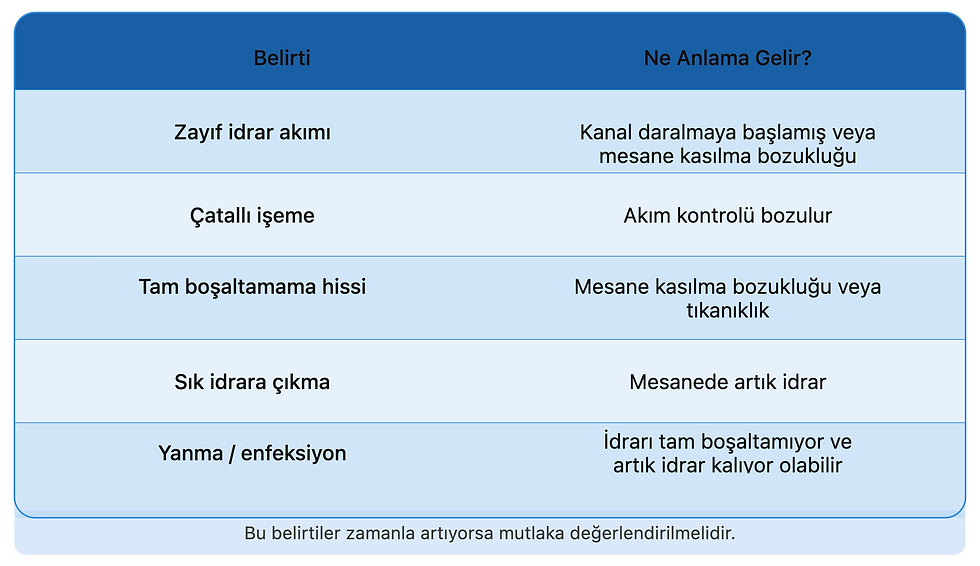
Urethral stricture is generally a slowly progressing disease. Therefore, patients may not notice their symptoms initially or may consider them normal age-related changes. However, symptoms become more pronounced over time.
The most common complaints are:
Significant decrease in urine flow rate (weak flow)
Urination in a forked or splashing manner
Difficulty initiating urination
Straining to urinate
Prolonged dripping at the end of urination
The feeling of not being able to completely empty the bladder.
Frequent urination
Recurrent urinary tract infections and burning.
These symptoms usually increase gradually and become more pronounced as the disease progresses. In advanced stages, the urinary tract may be completely blocked, requiring emergency intervention.
Can urethral stricture be confused with other diseases?
Yes, urethral stricture can present with symptoms similar to many other urological diseases. Therefore, differential diagnosis is very important.
The most common diseases that can be confused with it are:
Prostate enlargement (BPH): The most common condition that causes confusion in older men.
Prostate cancer
Bladder neck stenosis
Neurogenic bladder: Bladder dysfunction due to nervous system disorders.
Since all of these diseases can cause similar symptoms, an accurate diagnosis should be made with appropriate tests.
Does urethral stricture resolve on its own?
Urethral stricture does not resolve spontaneously. This is because it is not a temporary constriction, but a permanent tissue change. It may remain stable over time, but it often tends to progress.
Can urethral stricture be treated with medication?
Medication does not eliminate urethral stricture. It only treats or provides temporary relief from infection, if present. Opening the stricture usually requires interventional treatment.
What should you do?
Urethral stricture is a condition that is easier to treat when detected early, but can lead to serious complications if neglected.
If you notice a weakening in your urine flow, don't wait. Early diagnosis means easier treatment. Patients who notice changes in their urine flow should consult a urologist without delay, as this directly affects the success of treatment.
Frequently Asked Questions
Does urethral stricture resolve spontaneously? No. Urethral stricture is a structural problem, mostly caused by scar tissue, and is not expected to resolve spontaneously.
Will it improve with medication? No. Medication can help control any accompanying infection or inflammation, but it won't eliminate the existing narrowing.
Can it be confused with prostate diseases? Yes. Urethral stricture can be mistaken for prostate diseases due to symptoms such as weakened urine flow, frequent urination, or difficulty urinating. Therefore, evaluation by a specialist physician is important for an accurate diagnosis.


Comments